
What does the new RSPCA Australia Standard mean for the Better Chicken Commitment?
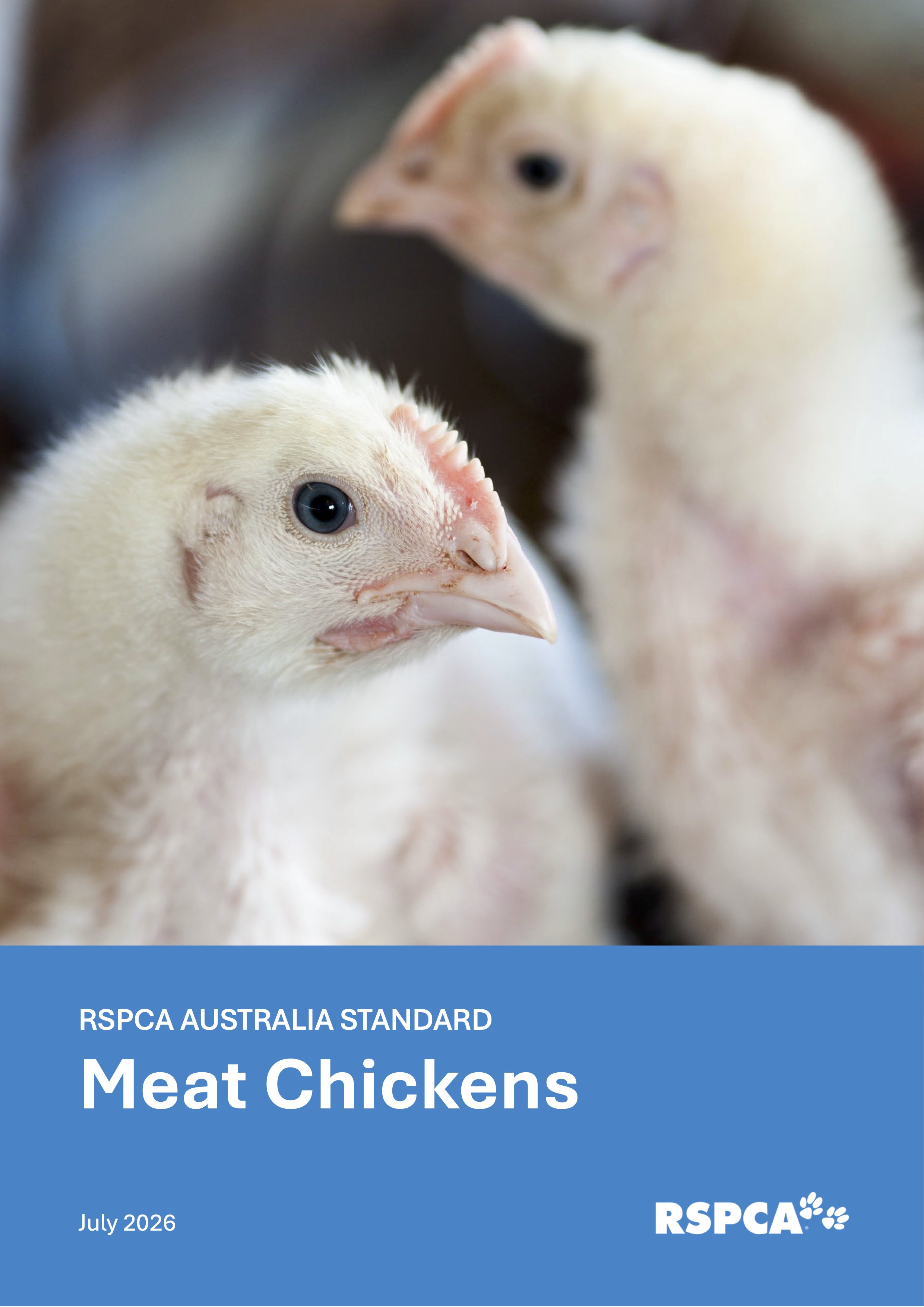
In July, RSPCA Australia released a new version of their Meat Chicken Standard – the official document that sets out requirements for their farmed animal welfare certification program, marketed as RSPCA Certified.
The 2026 RSPCA Australia Standard includes some significant animal welfare improvements – but are they enough to meet the Better Chicken Commitment? Here's more on why the RSPCA Australia Standard matters, and how this affects progress for the BCC in Australia.
Why do we need a certifier?
One of the criteria of the Better Chicken Commitment is third-party auditing. This means that food businesses need to use an independent auditor to demonstrate their progress towards meeting the animal welfare requirements of the Better Chicken Commitment.
RSPCA Certified is Australia’s largest and most recognised independent animal welfare certification program and it currently covers 97% of meat chickens in Australia. Which is why it’s so important that the RSPCA provides a pathway for certifying slower growing, healthier breeds.
How does RSPCA certification work?
RSPCA Australia’s science team is responsible for developing and reviewing the RSPCA Australia Meat Chicken Standard, which sets out the requirements for certification.
The core certification requirements cover chickens raised indoors. Where chickens are provided access to the outdoors, additional free-range requirements apply.
RSPCA Certified is a separate business unit of RSPCA Australia. The RSPCA Certified team is responsible for auditing and compliance, i.e. checking that farms are meeting the requirements of the Standards that match up with how they are marketed (indoor or free range).
Getting certified is optional – chicken producers and food businesses choose to apply to RSPCA Certified and, in return, can use RSPCA Certified labelling on their products and marketing materials.
Does the new 2026 RSPCA Standard meet the Better Chicken Commitment?
“The new RSPCA requirements for slower growing breeds provides Australia’s first - and currently only - certification pathway to meet the Better Chicken Commitment.”
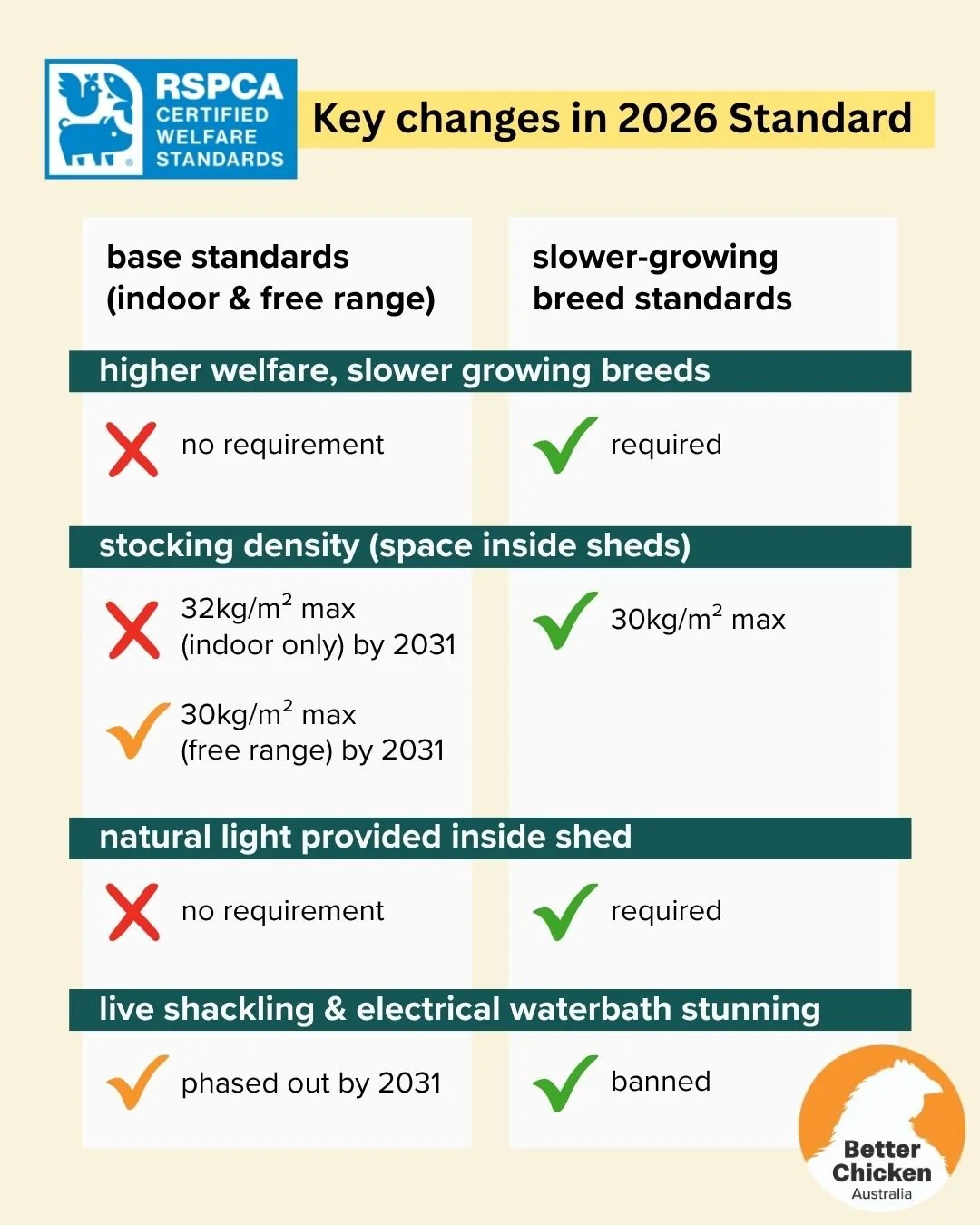
There are some significant improvements in the core requirements of the 2026 RSPCA Australia Meat Chicken Standard, including for air quality, lighting, catching and transport. The 2026 Standard also includes a reduction in maximum stocking density and an end to the use of electrical waterbath stunning – but neither of these changes kick-in until 2031.
Disappointingly, the 2026 Standard still allows inhumane, fast-growing chicken breeds. There is no phase-out date for these breeds.
This means that, for years to come, chicken products labelled as RSPCA Certified can continue to come from birds suffering from the serious welfare problems associated with selection for rapid growth.
However, there is a silver lining. In the same way that free-range requirements are an add-on to the core RSPCA Australia Standard, they have now introduced additional requirements for higher welfare, slower growing breeds.
The new RSPCA requirements for slower growing breeds provides Australia’s first - and currently only - certification pathway to meet the Better Chicken Commitment.
RSPCA’s new slower-growing breed certification level
RSPCA Australia’s new certification level for slower growing chickens is available now and includes the following BCC-aligned requirements:
Only approved slower growing, higher welfare chicken breeds are permitted.
Lower stocking density, meaning chickens get more space inside sheds.
Natural light must be available in all sheds, and overall lighting levels increased to encourage activity.
Birds must have easy access to perches, platforms and at least two different types of pecking enrichment.
Air quality in the sheds is maintained to keep ammonia and carbon dioxide well below harmful levels.
Good quality litter must be provided at an average depth of 5cm across the entire shed floor.
Thinning (removing some of the chickens from the shed for early slaughter) is limited to once per flock.
No live shackling or electrical waterbath stunning is permitted.
For producers and food businesses who want to transition away from fast-growing breeds and meet the BCC, the first step is for them to maintain or gain RSPCA certification. From there, companies can chart their roadmap towards full compliance with all BCC requirements, which is now made possible through the new RSPCA level for slower-growing breeds.
Next steps
RSPCA Australia has provided a pathway to the BCC – but it’s up to food businesses to decide to take it. That’s where you come in.
Chickens need you to help show businesses that their customers want better animal welfare standards.
As we saw with the shift to cage-free eggs, when there’s demand for higher animal welfare, businesses will change their products to meet that demand – especially when there’s an opportunity to stand out against their competitors.
Without your help, the chicken industry will continue breeding chickens to grow too fast for their bodies to cope. We need to demand change.
You can help right now by visiting our actions page where you can write to food businesses, telling them that it’s time to join the Better Chicken Commitment.
It’s time for better chicken standards
Right now, the Australian chicken industry is failing chickens and consumers.
Join thousands of Australians demanding better.
Already signed up? Check out our action hub to find out more ways to help chickens.